how old is China’s culture and where did it begin
Everlasting Rivers: The Origins and Historical Depth of Chinese Civilization
Renowned worldwide for its immense antiquity and enduring vitality, Chinese civilization stands as the sole uninterrupted ancient civilization that has persisted down to the present day across the globe. To grasp its profound history and developmental origins, we must look past the veil of myth and legend and turn to empirical archaeological discoveries. Broadly speaking, the prehistoric foundations of Chinese culture stretch back roughly 10,000 years, while the verified history of Chinese civilization in the form of statehood spans more than 5,000 years.
I. Quantitative Benchmarks of Its Age-Long History
Several pivotal chronological markers define the timeline of Chinese cultural development:
-
A 10,000-Year Cultural History:
Research conducted under the Chinese Civilization Origins Project confirms that agricultural origins emerged in China approximately 10,000 years ago: rice cultivation took root in southern China, while millet (foxtail and broomcorn millet) was domesticated in the north, laying the economic bedrock for the birth of civilization.
-
A 5,000-Plus-Year Civilization History:
This is no empty claim. Major archaeological initiatives, including the Chinese Civilization Origins Project, have empirically proven that Chinese civilization evolved into an early state society by roughly 5,100 years ago. This conclusion is firmly backed by landmark archaeological finds such as the Archaeological Ruins of Liangzhu City and the Taosi Site.
II. Origins: From a “Starry Sky of Civilizations” to Unity in Diversity
The origins of Chinese civilization were once depicted as a single-centered system focused solely on the Yellow River; the now-debunked theory of the “Western origin of Chinese culture” also once gained traction. Modern archaeological findings have thoroughly overturned this narrative.
1. The Dawn of Civilization: A Pattern of Countless Stars in the Sky
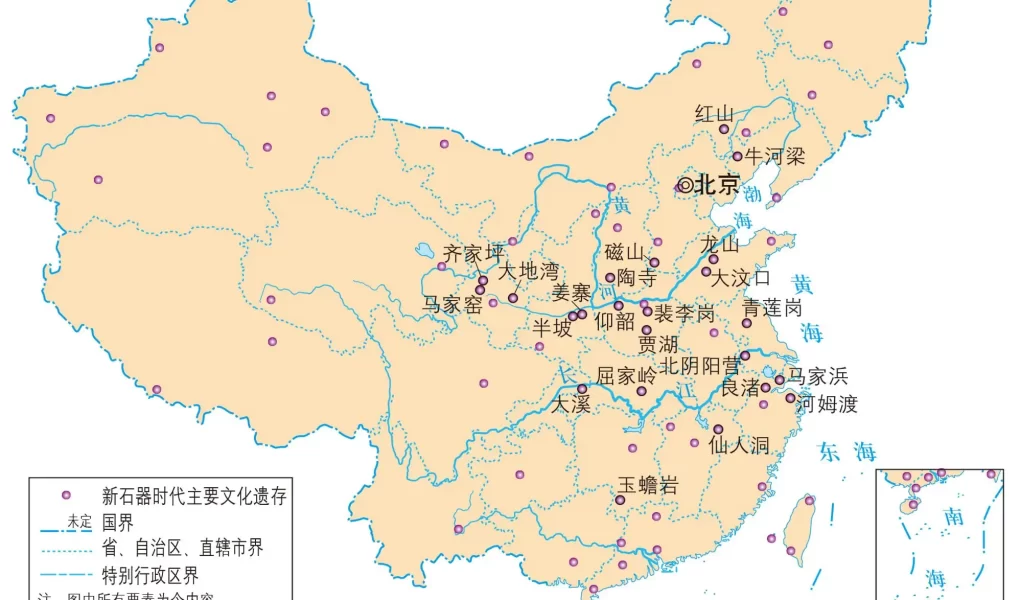
Chinese civilization did not originate from one single location; instead, it sprouted independently across the vast landmass of China, forming a landscape vividly described as a “starry sky” of civilizations. Key prehistoric cultural spheres include:
-
Middle and Lower Reaches of the Yellow River: Peiligang Culture (c. 8,000 years ago), Yangshao Culture (7,000–5,000 years ago), Dawenkou Culture, and Longshan Culture.
-
Lower Reaches of the Yangtze River: Hemudu Culture (c. 7,000 years ago), Liangzhu Culture (5,300–4,300 years ago).
-
Liao River Basin: Xinglongwa Culture, Hongshan Culture (6,500–5,000 years ago). Its large-scale sacrificial sites and jade artifacts such as the jade pig-dragon bear witness to sophisticated social hierarchies.
-
Other Regions: The Jianghan Plain, South China, Northwest China, and beyond all host abundant prehistoric cultural relics.
These regional cultures developed autonomously while engaging in constant exchange, collision, and integration, collectively constituting the fountainhead of Chinese civilization.
2. Key Archaeological Sites and the Formation of Core Cultural Genes
Among these myriad cultural centers, pivotal sites clearly record the initial shaping of China’s inherent cultural DNA:
-
Jiahu Site, Wuyang, Henan (9,000–7,500 years ago): The site yielded bone flutes (possibly the earliest musical instruments or astronomical pitchpipes ever discovered), carved symbols on tortoise shells (linked to divination and the genesis of primitive writing), and orderly clan burial grounds, reflecting early ancestor worship and a structured social order.
-
Qiaotou Site, Yiwu, Zhejiang (c. 9,000 years ago): The world’s earliest painted pottery was unearthed here, alongside symbols resembling the yin-yang trigrams of the I Ching, evidencing the emergence of early Bagua (Eight Trigrams) cosmology.
-
Gaomiao Site, Hongjiang, Hunan (c. 7,800 years ago): Exquisite patterns of flying dragons, phoenixes, and eight-pointed stars adorn white pottery from the site, proving that as early as 7,000 to 8,000 years ago, ancient Chinese ancestors held reverence for heaven and embraced a cosmic worldview (such as the concept of heaven being round and earth square).
-
Chahai Site, Fuxin, Liaoning (c. 8,000 years ago): A nearly 20-meter-long stone-sculpted dragon was uncovered here, providing some of the earliest tangible archaeological evidence for the cultural identity of the “descendants of the dragon.”
These discoveries demonstrate that by roughly 8,000 years ago, core cultural tenets including reverence for heaven and ancestors, integrity, benevolence, harmony, and universal great unity had already taken initial shape across China.
III. The Official Formation of Civilization: From Ancient States to Dynastic Kingdoms
The transition from scattered regional cultures (the starry sky pattern) to an integrated early state marked the defining turning point in the formation of Chinese civilization.
-
Liangzhu Ancient State (5,300–4,300 years ago):
Located in the lower Yangtze River basin, the Liangzhu Site stands as the most critical archaeological proof for China’s 5,000-year civilization history. It boasts a colossal ancient city complex, sophisticated hydraulic systems, graded burial cemeteries, and exquisite jade artifacts (cong cylinders, bi discs, yue battle-axes) embodying combined royal and theocratic power. Mainstream Western archaeological academia widely recognizes Liangzhu as East Asia’s earliest state-level society.
-
Taosi Site (4,300–3,900 years ago):
Situated in Xiangfen, Shanxi, the Taosi Site is regarded by numerous scholars as “the earliest China” or the capital Pingyang of Emperor Yao. Spanning 2.8 million square meters, the walled city houses the world’s earliest astronomical observatory, palace compounds, granaries, and elite tombs furnished with dragon plates, jade ritual vessels, and other regalia, confirming its status as a mature early civilization.
-
Erlitou Site (3,800–3,500 years ago):
Located in Yanshi, Henan, the Erlitou Site is universally identified by academia as the mid-to-late capital of the Xia Dynasty, marking the advent of dynastic kingdom civilization in China. It contains China’s earliest enclosed imperial palace compound (the prototype of the Forbidden City), large-scale palace foundations, state-run handicraft workshops, and assemblages of bronze ritual vessels symbolizing monarchical power. This site pioneered the Bronze Age ritual civilization centered on the Central Plains.