Why print culture developed in China
The development of print culture in China was not simply a process of technological selection, but a prolonged evolution shaped by social structures, economic considerations, and intellectual demands. It unfolded in two distinct phases. In the pre-industrial era, woodblock printing remained dominant for roughly a millennium, as it was well adapted to China’s socioeconomic conditions. In modern times, however, under the influence of Western technology, Chinese printing underwent a difficult transition toward mechanization and mass accessibility. this is China culture.
📜 A Millennium-Long Dominance: Woodblock Printing and the “High-Level Equilibrium Trap”
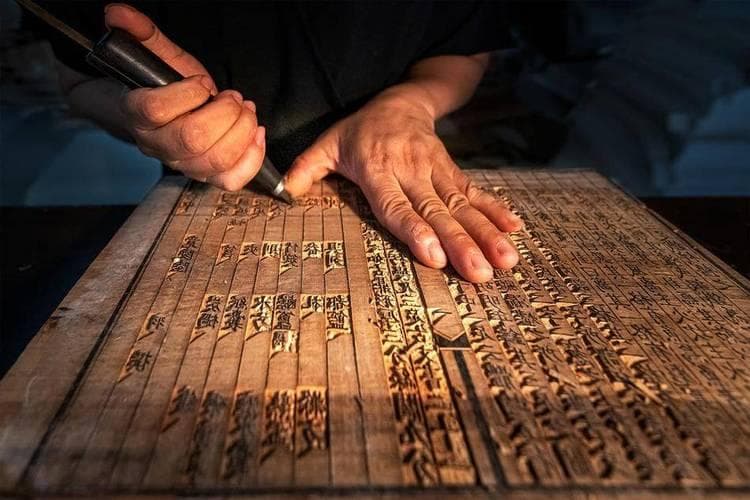
Although Bi Sheng invented clay movable type in Song China, centuries before Gutenberg, movable-type technology never displaced woodblock printing as the mainstream method. Several economic factors help explain this outcome.
Labour-cost advantages: The Ming and Qing dynasties had an abundant supply of relatively inexpensive labour. The availability of cheap skilled labour made labour-intensive woodblock engraving economically viable. By contrast, producing tens of thousands of individual Chinese movable-type pieces required substantial upfront investment, which was beyond the reach of many private book workshops.
Sunk-cost trade-offs in a long-tail market: Once carved, woodblocks could be preserved for decades and reused whenever a text was needed, resulting in very low marginal costs for subsequent print runs. Movable type, by contrast, had to be dismantled and reset after each printing job, creating additional costs whenever a new edition was required. For canonical and continuously demanded works such as The Four Books and Five Classics, woodblock printing was therefore often the more economically rational option.
This pattern can be understood in terms of Mark Elvin’s “High-Level Equilibrium Trap” theory. In a labour-abundant environment, technologies that conserved capital and resources could be more economically attractive than technologies primarily designed to save labour. Woodblock printing thus remained competitive not because movable type was technically impossible, but because the existing economic environment made woodblock printing highly efficient.
🌱 Origins: Technology, Institutions, and Demand
Woodblock printing took root during the Tang Dynasty as a result of several mutually reinforcing developments.
Material and technical prerequisites: The widespread availability of paper, the maturity of ink-and-brush techniques, and techniques derived from seals and stone rubbings provided important foundations for the development of woodblock printing.
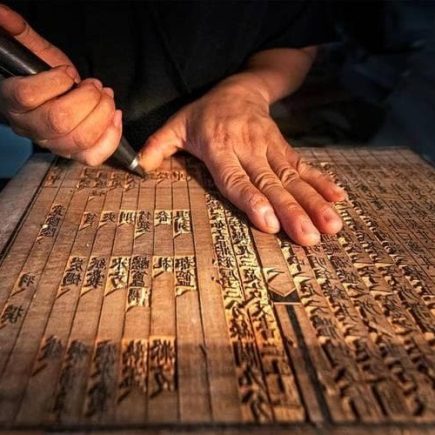
The stimulus of the imperial examination system: The expansion of the civil-service examination system from the Sui and Tang periods onward created strong demand for standardized texts and educational materials. As literacy and the circulation of texts expanded, the need for efficient methods of reproducing written works also increased. This broader intellectual and institutional environment contributed to the development of printing technologies, including the movable-type innovation later described by Shen Kuo in his Dream Pool Essays.
Religious and cultural diffusion: The widespread circulation of Buddhist scriptures and the growth of academies created strong demand for more efficient methods of reproducing texts than manual copying. These developments helped establish a sustained market for printed works and contributed to the expansion of print culture.
⚔️ The Modern Turning Point: The Impact and Transformation of Western Printing Technology
China’s print culture underwent a major transformation in the nineteenth century, increasingly shaped by Western technological influence and external pressures.
Missionary-led technology transfer: In the early nineteenth century, Western missionaries introduced lead movable type and mechanical printing presses to China. Initially used largely for religious and educational purposes, these technologies introduced new methods of textual production and reproduction.
A qualitative shift from “carving” to “casting”: Western metal movable type offered a more efficient and precise means of producing large quantities of Chinese-character type. Combined with mechanical power, it provided substantial advantages over traditional woodblock printing in terms of production speed and per-unit cost. The shift represented not merely the introduction of a new printing technology, but a broader transformation in the organization and economics of textual production.
The dawn of the information age: In the late twentieth century, the emergence of computer technology created new challenges for the processing of Chinese characters. In response, Wang Xuan and his team developed a Chinese-character laser phototypesetting system. This landmark breakthrough marked the transition from the era of “lead and fire” to that of “light and electricity,” helping overcome a major technological challenge in the digitization of Chinese script. In this sense, it can be regarded as China’s second major printing revolution.